About TRU Open Learning
TRU Open Learning strives to provide excellence in service and high quality education to meet the open and distance education needs of learners provincially, nationally and worldwide.
Through its legislative mandate, TRU Open Learning provides open, accessible and flexible learning, and recognition of all types of learning, to students. Built on the fundamental pillars of access to education and recognition of university-level learning obtained regardless of source, our open mandate means all types of learners have a real opportunity to successfully complete their education and grow their careers in the most efficient and effective manner possible. Furthermore, TRU Open Learning takes lifestyle and commitments into account and helps remove barriers that block access to quality post-secondary education.
Mission
- Strive to make post-secondary education available at a time and place and through delivery methods convenient to the learner.
- Expand the recognition and acceptance of credits earned at other national and international institutions through an established educational credit bank to broaden credential completion opportunities.
- Establish distance education as a viable complement to on-campus and classroom learning.
- Broaden participation in post-secondary education by developing programs that encourage and engage the learner.
Open admission
The flexible education environment offered by TRU Open Learning includes a continuous enrolment schedule and an open admission policy that sets it apart from other BC institutions. Our openness also extends to students at other colleges and universities who can choose to stay at their home institution and register with TRU Open Learning for the courses they need.
All persons are eligible for course registration and for general admission into most TRU Open Learning courses and credential programs.
Differential fees and services may apply to applicants who are classified as international students as well as non-permanent residents of British Columbia.
Courses and programs
Courses
TRU Open Learning provides approximately 550 transferable courses.
Self-paced courses
- Continuous registration
- Students have up to 30 weeks to complete the course.
- Offered on a non-semester basis
Paced courses
- Specific start and end dates
-
Cohort-based
Students register at specific times during the year
Programs
TRU Open Learning provides approximately 60 programs.
- Program students can accelerate their credential completion through prior learning assessment and recognition (PLAR) and through transfer credit.
- With PLAR, academic credits are awarded for previous knowledge and skills gathered from life and work experience.
- PLAR can help students expedite program completion, save money on tuition and transfer previously earned credits completed at other institutions into a TRU credential.
Founded on four fundamental pillars
Accessibility
Students do not need a specific GPA (grade point average) or secondary school transcripts for registration in most courses. Some programs require high school graduation, however.
Flexibility
Registration is open for continuous registration (non-paced) courses 365 days a year. Students can complete their coursework anywhere, anytime and at a pace that suits their lifestyle or commitments, whether that is on a full- or part-time basis. They can set their own study schedules and have flexibility regarding their final exam date and location.
Choice
Students have access to over 550 courses and a variety of certificate, diploma, degree, post-baccalaureate and master's programs in an array of disciplines. TRU Open Learning is BC's largest provider of online courses and programs.
Credibility
Backed by decades of experience in distance education, TRU Open Learning is part of a bricks-and-mortar university. Our Open Learning Faculty Members are highly credentialed and well-experienced in teaching in an online environment.
How TRU Open Learning serves students
TRU Open Learning develops many of its courses in-house with a team of subject matter experts, writers, instructional designers, editors and media experts. Courses are engaging and student-centred, and attention is given to quality, accuracy, relevancy and real-life application.
Student contact usually begins with an enrolment services officer, who answers questions via telephone and email and helps a student register. For those students who enrol in programs, dedicated program advisors design educational plans that help students successfully attain their credentials.
Enrolment services officers help students choose between Open Learning’s various scheduling and delivery options, whether courses are paced or continuous. Paced courses are cohort-based and students register at specific times during the year; continuous registration courses are non-cohort, non-paced and students can register whenever they want. Both paced and continuous courses have their advantages. All courses, with the exception of lab courses, are taken at a distance.
In all courses and programs, students receive personalized attention. They work one-on-one with their Open Learning Faculty Members, interacting mostly via email and the course's learning management system and occasionally by telephone. These interactions are student-driven, and they are motivational.
Students need not come to campus to take final exams. Students residing within Canada but outside BC can take final exams at one of Open Learning's Canadian Invigilator Network examination centres, providing they live within 100 km of that centre. Students within BC can take their final exams at an exam centre closest to them. TRU Open Learning can work with students to provide alternate arrangements, where necessary.
Is TRU Open Learning right for me?
Distance education means that you can study wherever you live and wherever you are: in a public library, at home, at work or overseas. But open education also means that you may begin your course or program whenever you like; there is no need to wait for a particular semester to begin.
It also means that people who would find it difficult to complete a course or program on a physical campus can still access post-secondary education. This includes people living in a small town without access to on-campus education, people with disabilities, working students and those with family commitments. TRU Open Learning also has few barriers to entry, so your ability to enrol won't be affected by your past academic records and you won’t be required to submit transcripts from secondary school to register in courses.
In addition, we offer students the opportunity to receive credits towards a program through PLAR, or Prior Learning Assessment and Recognition. This program is in place to recognize the experience and skills you have gathered from previous education, or life and work experience.
Registration
While you do have to register with us if you wish to complete an entire program, you don't have to be a registered TRU OL student to take a distance course. Some of our students are registered at other post-secondary institutions but find they can’t fit another on-campus course into their schedule. They are able to take an Open Learning course and transfer the credits to their own institution.
Support
Just because you are studying at a distance doesn’t mean you are studying alone. You will have the full support of your course Open Learning Faculty Member. In online courses, you may also collaborate with other students in your course.
We recommend that students taking full-time distance education courses for the first time take no more than three courses at a time. Students who are working full time are encouraged to start with only one or two courses at a time. We also recommend beginning with introductory (generally 100 level) and prerequisite courses.
History
Open Learning at TRU is BC’s leading open and distance education provider. It builds on the legacy of both the University College of the Cariboo (UCC) and the TRU Open Learning Institute (OLI).
On June 1, 1978, the British Columbia Colleges and Provincial Institutes Act created OLI to pioneer post-secondary education via distance education. OLI was a non-profit, fully accredited institution.
In 1988, OLI became the TRU Open Learning Agency, a BC Crown Agency with the primary function of managing two services: what became the BC Open University (BCOU) and the Knowledge Network.
Up until 2004, the Knowledge Network was an on-site creator, producer and broadcaster of televised educational programming; today, it operates as a commercial-free public educational broadcaster.
On April 1, 2005, UCC and BCOU amalgamated to form Thompson Rivers University. All programs and courses of BCOU became part of TRU under the TRU Open Learning division.
Today, through its legislative mandate, TRU Open Learning provides open, accessible and flexible learning and recognition of all types of learning.
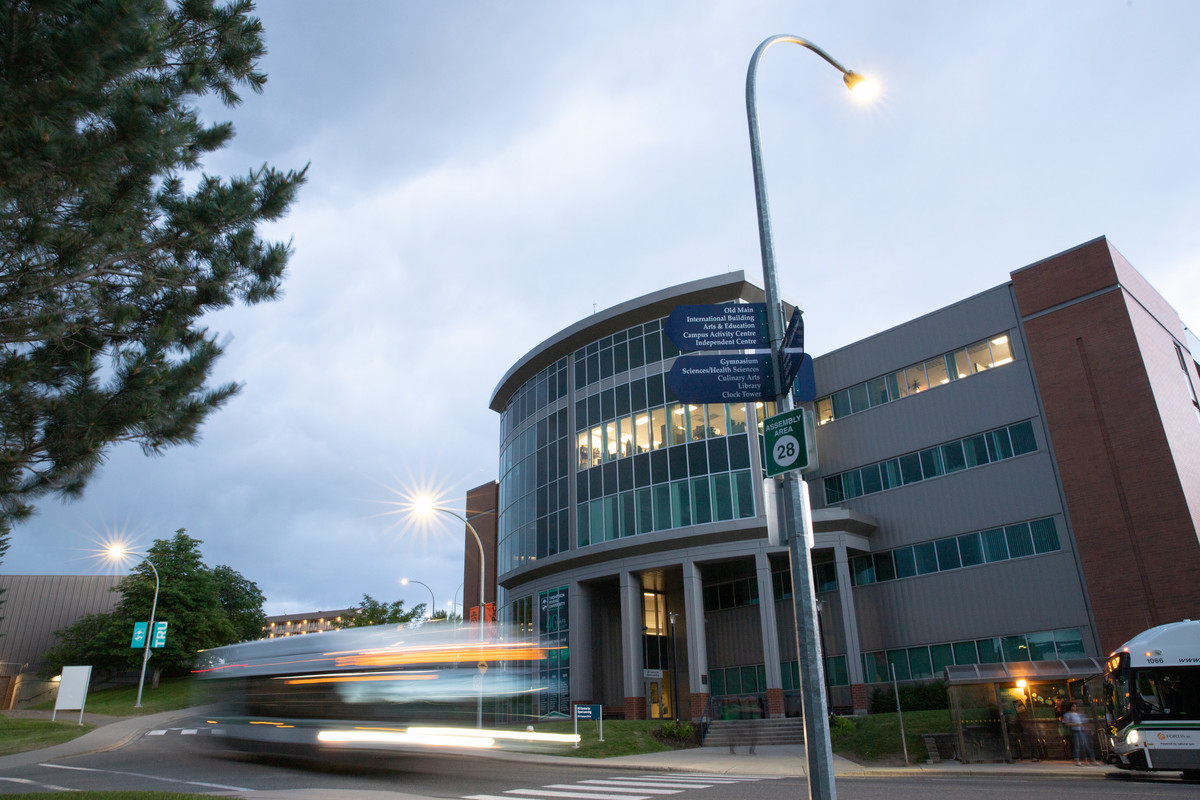
The BC Centre for TRU Open Learning is on the TRU campus in Kamloops.